
Choosing an Epoxy Floor System in Brevard County: Flake, Quartz or Metallic
Metallic
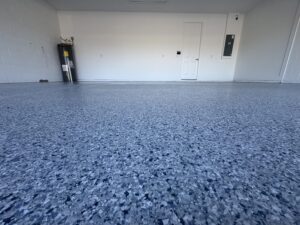
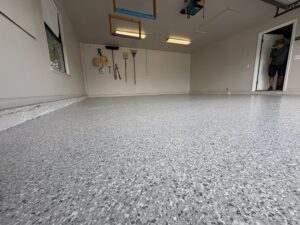
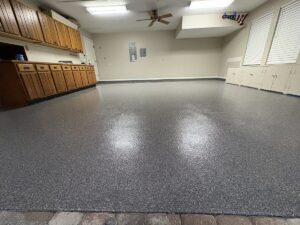
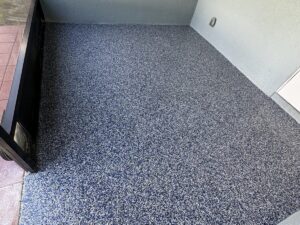
Flake
If you’ve been reading up on flake vs metallic epoxy floor options for a property in Brevard County, here’s the honest summary before you spend an afternoon on it: flake is the right answer for the overwhelming majority of floors. Quartz suits a narrower set of heavy-duty jobs at a higher price. Metallic is an interior-only decorative finish with real limitations, and we don’t recommend it for garages, patios or anywhere that gets wet.
Once you have compared the finishes, explore the installation details for flake flooring, quartz flooring and metallic epoxy flooring.
DJ Epoxy Solutions is a family-run business in Palm Bay. Javier Arnaez, our owner, has more than 30 years in construction and is on site for every job. Call (321) 398-1343 and he’ll tell you which system your space actually calls for — including when the cheaper one is correct.
What Are the Three Systems, Really?
Flake (also called chip)
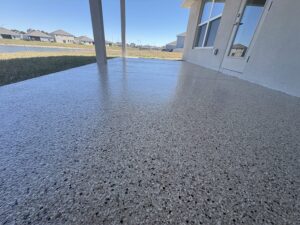
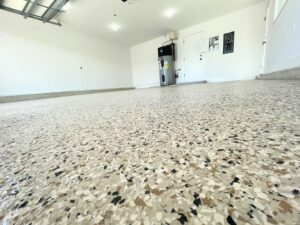
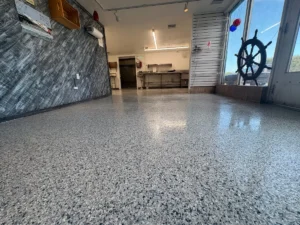
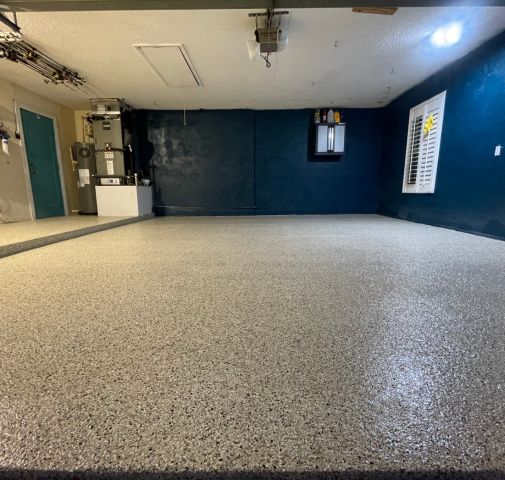
Colored vinyl flakes broadcast into a wet pigmented epoxy base, sealed under a clear polyaspartic topcoat. The flake gives the surface its texture, which is where the slip resistance comes from, and the blend hides minor imperfections in the slab. “Flake” and “chip” are two names for one system — if two companies quote you each term, they’re quoting the same build.
This is what we install on most garages, lanais, patios, laundry rooms and light commercial floors across Brevard.
Quartz
Graded quartz aggregate instead of vinyl flake. The result is denser and more heavily textured, built for floors taking sustained heavy use — commercial kitchens, wet areas needing maximum grip, industrial traffic. It’s a genuinely different system, not a variation on flake, and it starts at $15 per square foot against flake’s $6.
Metallic
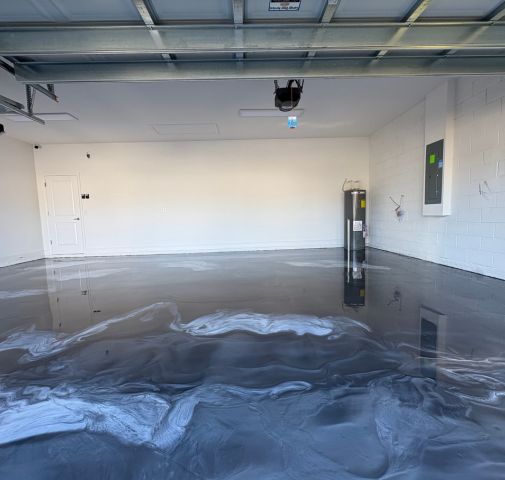
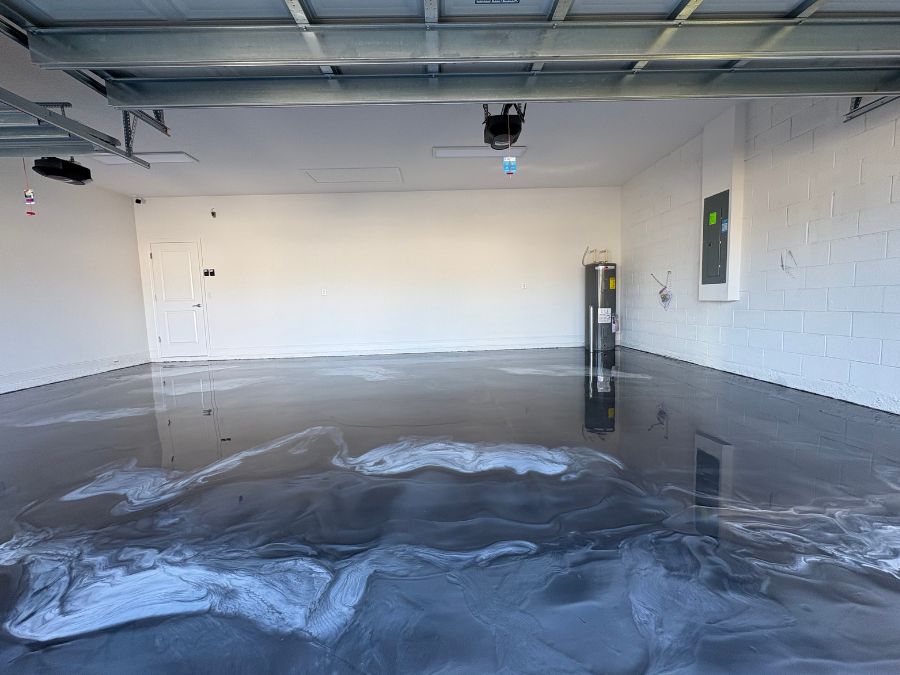
Metallic pigments worked into the base coat to produce a swirled, marble-like appearance. Two things matter about it: it’s smooth, with none of the texture flake and quartz provide, and it’s interior only. The smooth surface is the bigger constraint — it’s why we don’t put it in garages, on patios or around pools. It’s a decorative finish for interior spaces where appearance is the priority and the floor stays dry.
Which System Does Your Space Need?
Garage. Flake. Oil and water end up on a garage floor whether you plan for it or not, and you want texture underfoot. See garage epoxy across Brevard County.
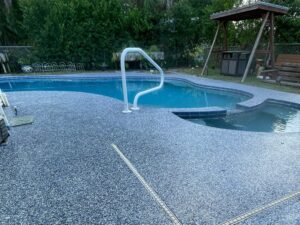
Patio, lanai or pool deck. Flake, with a non-slip additive in the topcoat. These surfaces are wet, walked on barefoot, and fully exposed to weather — metallic is unsuitable on every count. See pool deck coatings.
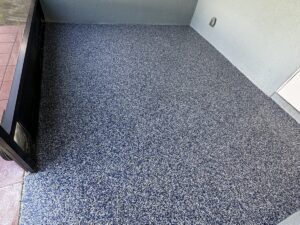
Interior rooms. Flake for kitchens, laundry rooms, hallways and sunrooms. Metallic is an option in a dry interior space if you want that look and understand there’s no texture. More on residential epoxy flooring.
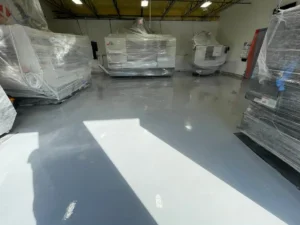
Retail, office or workshop. Flake handles most of it. Quartz where the floor takes heavier punishment or needs maximum grip. See commercial epoxy flooring.
Javier will walk the space with you and say which fits. If your slab has issues, he’ll tell you that too, before anything gets scheduled.
What Do the Systems Cost in Brevard County?
Across everything we install, coatings run $6 to $15 per square foot. Where you land depends on the system, the size of the area and the condition of the slab.
Flake, priced by space:
- $1,800 — one-car garage, 250–300 sq ft
- $2,500 — two-car garage, 400–500 sq ft
- $3,300 — three-car garage, 580–750 sq ft
- $2,000 — patio or lanai, 200–400 sq ft
Quartz starts at $15 per square foot. Metallic starts at $9 per square foot, interior only. Both of those are unit prices, not project totals — a 400 sq ft interior room in metallic starts around $3,600, not $9. Worth being clear about, because that’s a common misreading.
Those figures assume concrete in reasonable condition. An old coating that has to come off, cracking beyond a surface fill, or moisture in the slab all change the number, and none of it shows in a photo. Standard crack and pit repair sits inside the quote.
How Long Does Installation Take?
Installation time depends on the concrete condition, preparation required, selected coating system, project size and site conditions. Confirm the installation schedule for the actual floor with Javier before planning access or moving belongings. Other spaces vary with size and slab condition. For a realistic schedule on your project, plus how booking works, call Javier at (321) 398-1343; he runs the calendar himself and gives you actual dates.
Installation and curing schedules depend on the selected system. The general return-to-use guide after completed installation is:
- about 8 hours before foot traffic
- about 72 hours before parking a vehicle
DJ Epoxy Solutions generally recommends about 8 hours before walking and about 72 hours before vehicles or heavy use after the completed installation. These are return-to-use guidelines, not a promise of full cure. The selected system, site conditions and Javier’s project-specific instructions determine the actual timing.
These are general return-to-use guidelines, not a promise of full cure. Going on early leaves marks that don’t come out.
How Does the Installation Differ Between Systems?
Preparation is identical. Whatever goes on top, we diamond grind the slab to open the surface so the coating bonds mechanically into the concrete rather than resting on it. Old coatings come off here, cracks and pits get repaired, and everything is vacuumed clean. This step is what decides whether any of these systems is still holding in year five.
Flake and quartz follow the same sequence from there: pigmented base coat, aggregate broadcast into it while wet, then scraped back and vacuumed once set, then two coats of polyaspartic. Quartz simply uses a different, heavier aggregate.
Metallic works differently. Pigments are blended into the base coat and then worked across the surface to develop the pattern before it sets. There’s no broadcast stage and no texture built in — the finished surface is as smooth as the topcoat over it. That’s the reason for the interior-only limitation, more than the pigments themselves.
One clarification worth making: the UV stability in any of our floors comes from the polyaspartic topcoat, not from the flake. What keeps metallic indoors is the smooth surface and the pigment behavior, not a missing topcoat.
What Does the Warranty Cover?
Interior installations carry a lifetime warranty against installation and manufacturer defects. That applies to all three systems when installed indoors, including enclosed garage floors.
Which Areas Do We Cover?
We install throughout Brevard County — Palm Bay (32905, 32907, 32909), West Melbourne, Melbourne (32901, 32904, 32935), Suntree and Viera (32940), Rockledge (32955), Cocoa (32922, 32926) and Merritt Island, plus the beachside communities from Cocoa Beach down to Melbourne Beach.
South of the county line we cover Sebastian, Micco and Vero Beach in Indian River County. Pricing doesn’t change with the drive.
Frequently Asked Questions
Can I put metallic epoxy in my garage?
DJ Epoxy Solutions does not recommend Metallic epoxy for garages. Discuss the intended use, expected oil and water exposure, and the finish and texture appropriate for the actual garage assessment.
Is a chip floor the same as a flake floor?
Yes, two names for one system. Quartz is genuinely different: a separate aggregate starting at $15 per square foot against flake’s $6.
Which system works outdoors?
Discuss the complete system proposed for the actual outdoor exposure, existing concrete, drainage and traction requirements. Metallic is intended for interior design applications; a decorative finish name alone does not establish outdoor suitability.
Which is easier to maintain?
Ask for the care instructions for the exact installed system, including suitable cleaning products, spill response and any limits on rinsing. Do not assume all finishes have identical maintenance requirements.
What’s the actual price difference?
Flake garages start at $1,800. Metallic starts at $9 per square foot and quartz at $15 per square foot, both interior-priced by area rather than as a flat project figure.
When can I use the floor?
DJ Epoxy Solutions generally recommends about 8 hours before walking and about 72 hours before vehicles or heavy use after the completed installation. These are return-to-use guidelines, not a promise of full cure. The selected system, actual conditions and Javier’s project-specific instructions determine the release time.
Get a Free Estimate
Call Javier directly at (321) 398-1343 — you’ll reach the owner, not a call center. He’ll look at the slab, bring samples, and tell you which system fits before quoting. Questions about timing, scheduling or system selection are best answered on that call.
📞 Call: (321) 398-1343
📱 Text: (321) 398-1343
💬 WhatsApp
✉️ javier@djepoxysolutions.com
DJ Epoxy Solutions
2475 Palm Bay Rd NE, Suite 115-5
Palm Bay, FL 32905
Related Epoxy Flooring Services & Service Areas
- Flake & Quartz Epoxy Floor Systems Explained
- Garage Epoxy Flooring Across Brevard County
- Epoxy Flooring Across Brevard County — Full Service Overview
- Garage Epoxy Flooring Installation
Prices shown are starting points reviewed and approved as of July 2026 and valid through December 31, 2026. Pricing may change with season and material costs. For your current exact price, call (321) 398-1343 for a free estimate.
For more help choosing a finish, visit our epoxy floor system guide hub and follow the guides for garages, interiors and outdoor spaces.